
Strategy7 min read
HARO vs Guest Posts: Which Moves Rankings Faster?
Both work. But they work differently, on different timelines, for different goals. This is the honest breakdown.
Dot Mirror EditorialApr 29, 2026
Buyers now shortlist by asking an assistant. We make sure it names you.
Software we build and run ourselves.
The pages that convert for a SaaS company are the ones that never earn links on their own. Here's how to build authority where it changes pipeline, not just where it's easy.
Dot Mirror EditorialOct 29, 2026
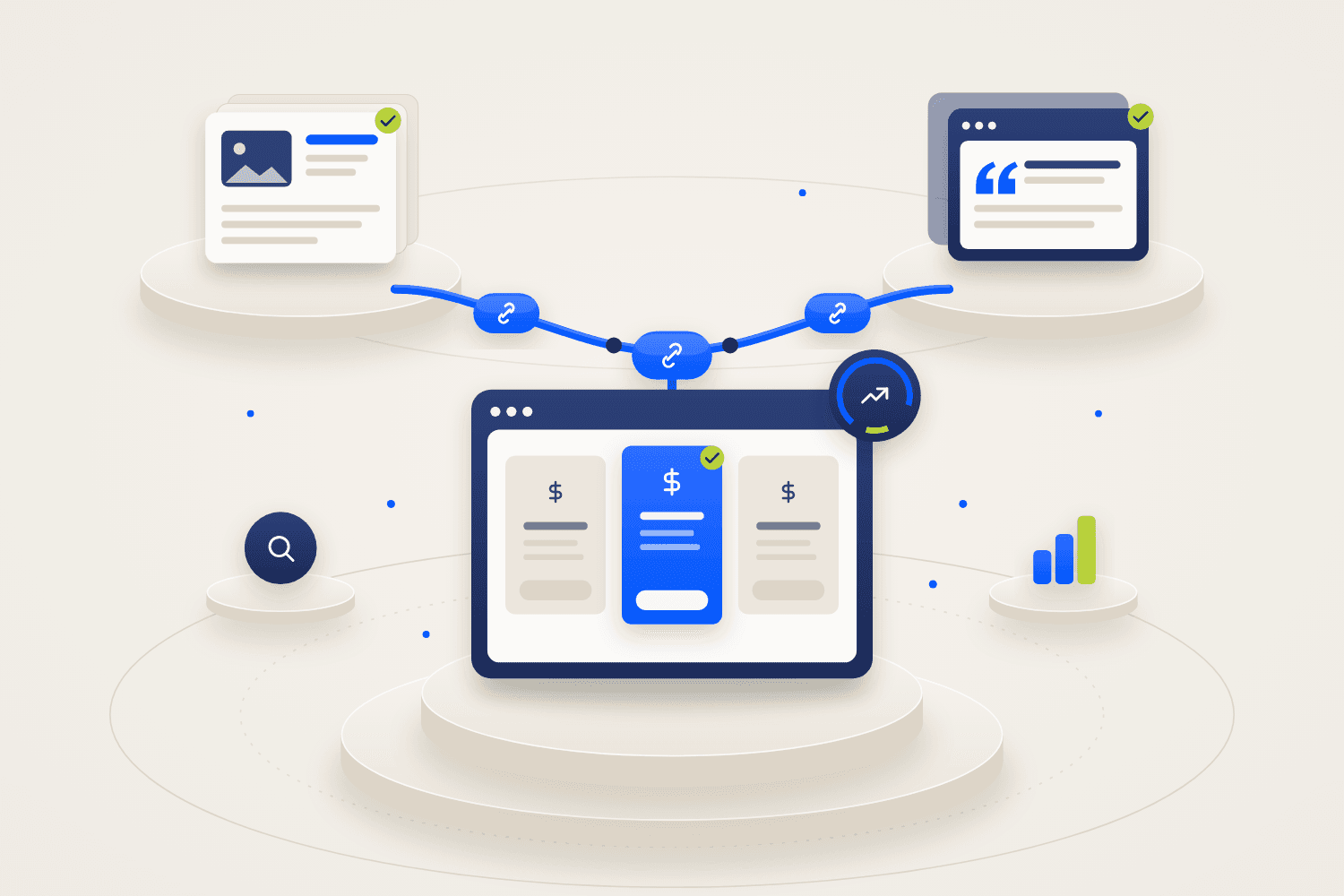
Most B2B SaaS companies do not have a content problem. They publish twice a week, rank for their brand and a long tail of posts — and the category term that actually converts still belongs to someone else.
More content has not changed that.
And it is not going to.
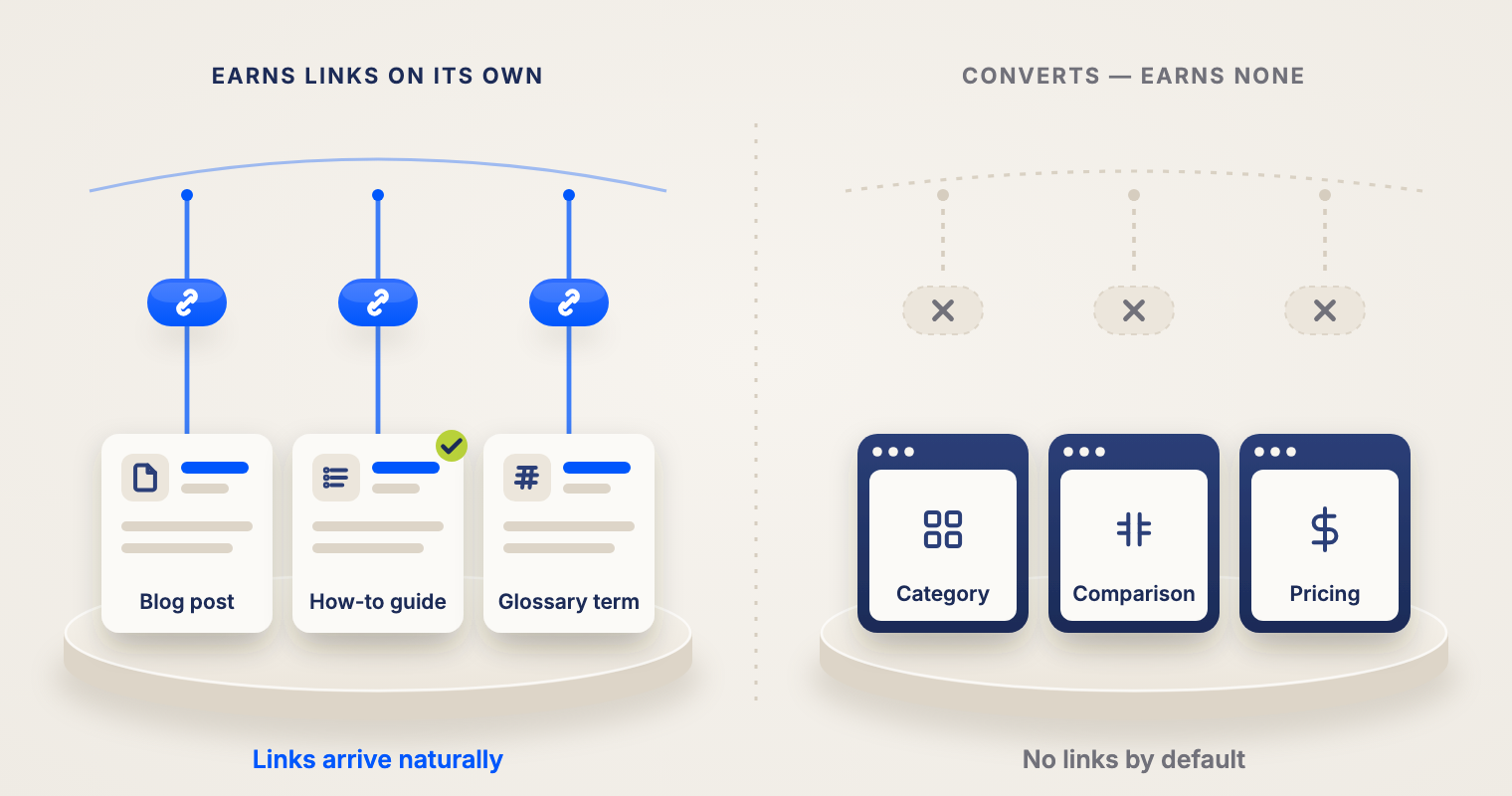
A blog post about "how to run a sprint retro" earns links on its own.
People reference it. Round-ups include it. Other writers cite it.
Your category page — "project management software," "ETL platform," "SOC 2 compliance tool" — earns almost none. Nobody links to a sales page as a favour.
So the asymmetry builds quietly.
Your informational content piles up authority it does not need to convert. The pages that carry revenue stay thin and stuck.
You can publish for two more years and the gap will not close — because the gap was never about how much you write.
Three kinds of pages decide most SaaS revenue:
All three resist organic links, because editors do not link to sales pages.
That is why so much SaaS content ranks beautifully while the pages that close deals sit on page two.
It is tempting to grade a campaign by how much your Domain Rating climbed.
For a SaaS buyer-journey, that number means little on its own.
A high-DR link with no topical relationship to what you sell does far less than a lower-DR link from a publication your buyers actually read.
We explain why in DR alone does not tell you a link is good. For SaaS, relevance and real traffic beat the raw score.
The honest scoreboard isn't "links acquired." It's movement on the terms that convert — and whether you show up where buyers evaluate.
Most SaaS teams have already tried one of the first two. Here is the honest comparison of where each one points its effort.
| Dimension | In-house content | Typical link agency | Deliberate approach |
|---|---|---|---|
| Target pages | Blog posts, easiest to earn | Whatever inventory allows | Category & comparison pages |
| Inventory quality | Whatever outreach lands | Lists competitors buy too | Traffic-verified, not DR alone |
| AI visibility | Not measured | Not offered | Tracked across engines |
| Anchor strategy | Ad hoc | Per order | Planned across the campaign |
Pointing authority at commercial pages is the whole game.
It is also where teams get nervous — a sales page that suddenly collects keyword-rich anchors looks exactly like a bought profile.
The fix is not to avoid linking to money pages. It is to support them with editorial links and link inserts inside content buyers already read — and to plan the anchor mix across the whole campaign so a commercial page never ends up with an obviously manufactured profile.
The most reliable coverage a software company can generate is a story built from data only it has.
Usage patterns. Adoption curves. Pricing benchmarks.
Turned into a defensible finding, that data earns links from journalists who link by name, to your domain — because the data is the story.
Expert commentary is the second lever, and the landscape there has shifted.
HARO, the original reporter-query service, was discontinued under Cision's "Connectively" brand at the end of 2024, then sold to Featured.com and relaunched as a free service in 2025.
Reporter-query platforms still work for SaaS — when your engineers and founders have something genuinely expert to say. That credibility is what gets a pitch accepted. We compared the trade-offs in HARO vs guest posts.
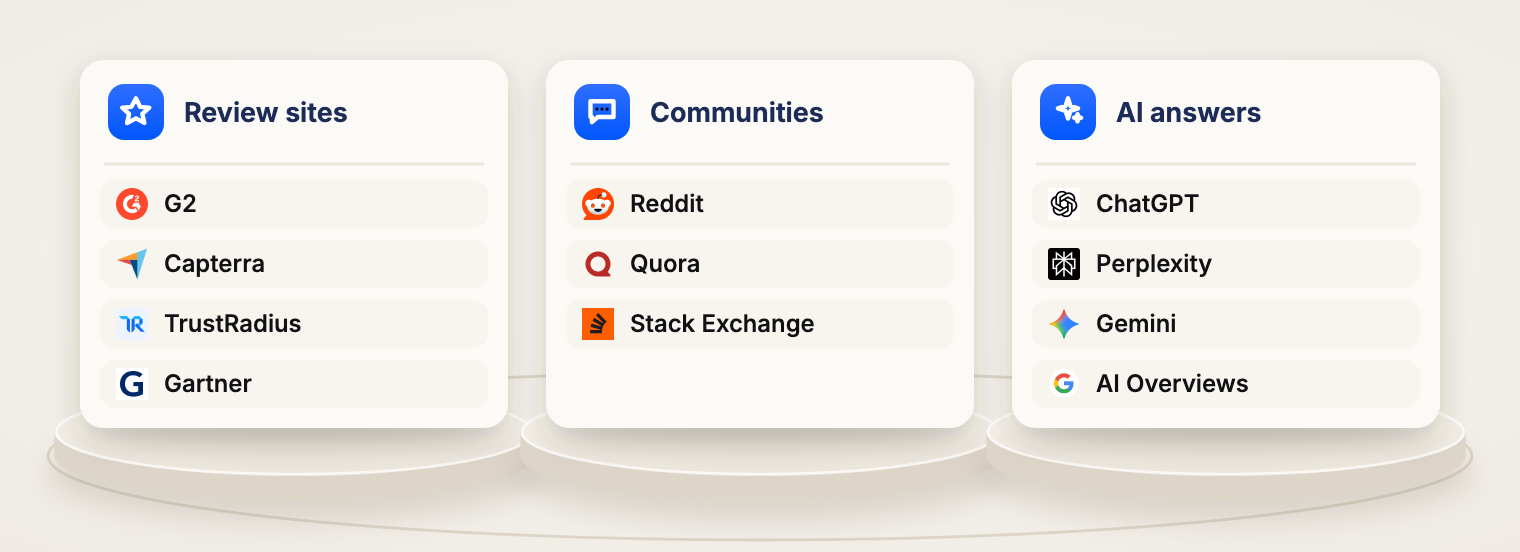
Considered software purchases are rarely decided on your website.
They are decided on review sites, in community threads, and — increasingly — inside an AI answer.
None of those sell placements. You cannot buy your way onto a Reddit thread that ranks for your category, or into a G2 round-up. You earn your way there.
That makes AI search its own surface.
Google's AI Mode breaks a question into sub-queries and answers from across the web — a technique Google calls "query fan-out" — and rolled out to US searchers in 2025.
What helps you appear there is not a trick or a special schema.
It is being cited by credible sources an engine already trusts, and having a clean, resolvable brand entity.
If your blog ranks but the page that sells won't move, the gap is almost never more content.
See our approach to SaaSAuthority building is slow, and then it compounds.
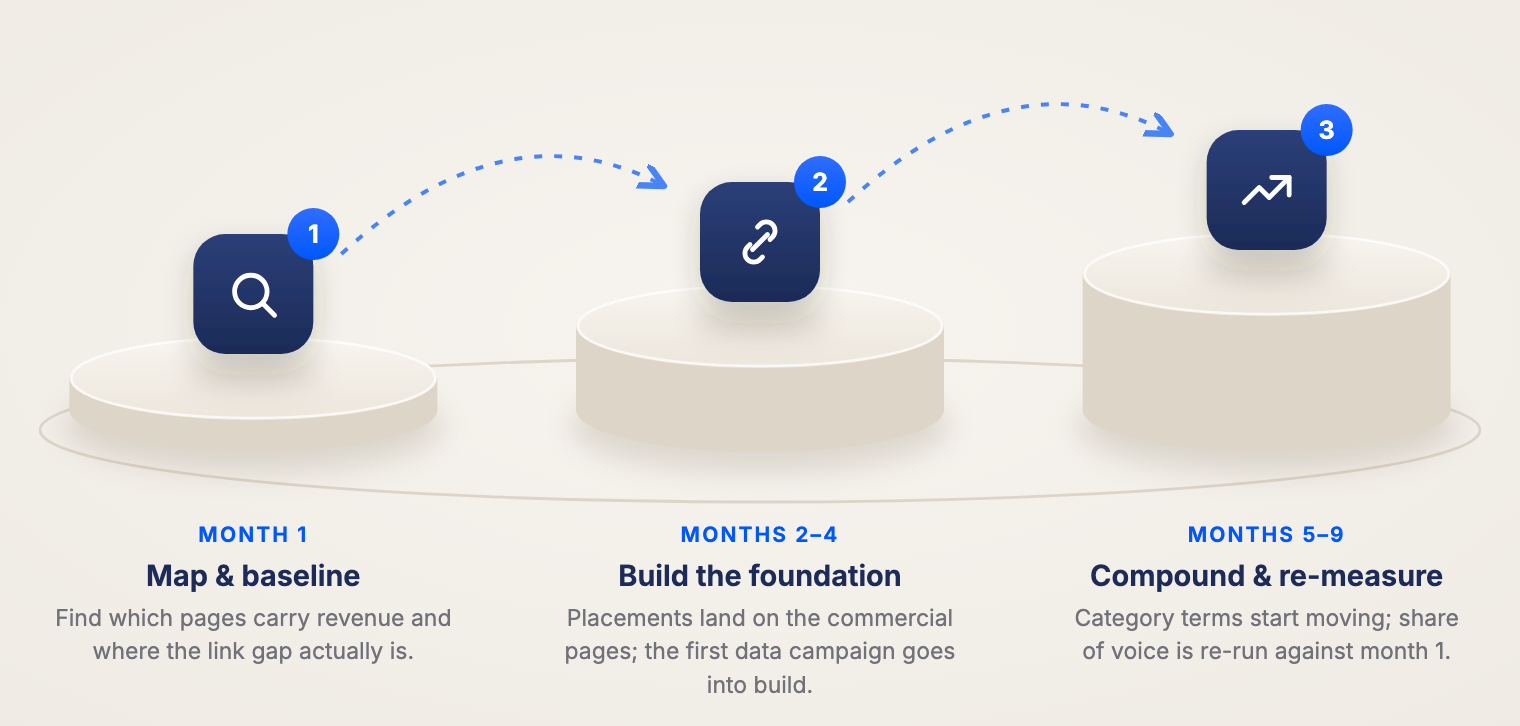
In our experience, movement on competitive category terms typically begins around three to four months in, and compounds through months six to nine.
AI visibility follows a similar curve, because it depends on new citations being published and then retrieved.
Those are typical patterns, not a promise. Timelines depend on your starting authority, your competitive set, and how linkable your commercial pages are to begin with.
"Done" is not a link count.
It is the category term moving, your commercial pages ranking where buyers can find them, and your brand appearing in the review and answer surfaces where the shortlist gets made.
If your blog ranks but the page that sells will not move, the gap is that nobody credible has linked to the page that converts.
That is the specific problem our approach to SEO for SaaS is built around. You can see how real campaigns were structured in our case study write-ups.
When you are ready to map it to your own category and commercial pages, brief your project — and we will start from where your authority actually needs to point.

Both work. But they work differently, on different timelines, for different goals. This is the honest breakdown.
Dot Mirror EditorialApr 29, 2026
We've watched dozens of companies try to build links in-house. The failure mode is almost always the same, and it's rarely about effort.
Dot Mirror EditorialApr 4, 2026
Domain Rating is a starting point, not an endpoint. Here's what most SEO teams miss when they evaluate link opportunities, and the three signals that actually predict whether a link will move your rankings.
Dot Mirror EditorialMay 14, 2026Wholesale, unbranded, no minimum. Tell us how you sell and we will talk you through the numbers.